Why I Uninstalled rtk: Saving Tokens Isn't Worth a Wrong grep
rtk rewrites an AI agent's shell commands to shrink their output. For my unattended Claude Code pipeline it also turned a correct grep into a confident zero, and the agent spent a morning asking me to add a config entry that was already there.

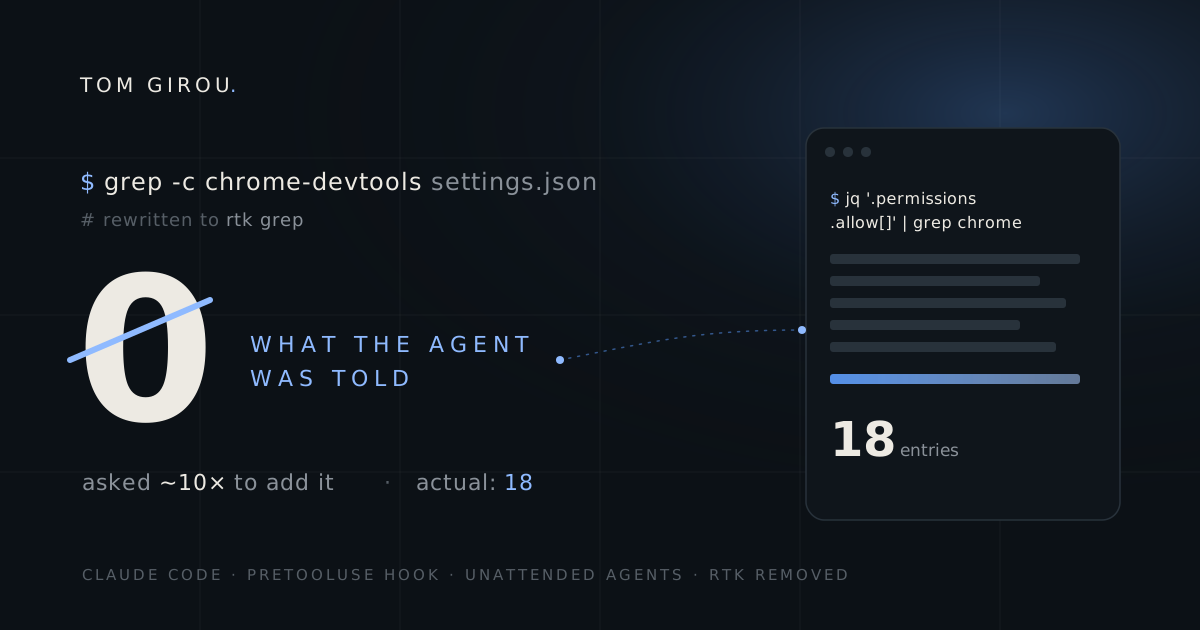
This morning my agent pipeline asked me the same question about ten times. Every pass of the triage loop, it checked a config file, found nothing, and wrote in my briefing that an entry was still missing and that I should add it.
I had added it at 09:23. The file had 18 matching lines. The agent wasn’t lying, exactly. It ran grep, grep said zero, and it believed grep. The problem was that the thing answering wasn’t really grep.
So I uninstalled rtk. Here’s why.
What rtk does
What is rtk? rtk, “Rust Token Killer”, is a small CLI proxy for AI coding agents. You wire it into Claude Code as a PreToolUse hook, and every Bash command the agent runs gets rewritten on the way out: git status becomes rtk git status, grep becomes rtk grep, cat becomes rtk read. rtk runs the real command and compresses the output before the model sees it. The pitch is 60 to 90% fewer tokens on routine dev operations.
The pitch isn’t wrong. A git log or a long ls is mostly noise to a model, and context is the scarce resource in a long agent session. I installed it, I liked rtk gain telling me how much it had saved, and for interactive work I barely noticed it was there.
My setup isn’t only interactive, though. I run an unattended pipeline (the one I mentioned in the disk-full post) that polls Jira and Gmail, writes me a morning briefing, and takes queued tickets all the way to a draft merge request. Headless claude -p runs, on systemd timers, with nobody watching the transcript as it happens. That’s where it went wrong.
The zero that wasn’t
What actually broke? A worker job for a client shop needed to reproduce a front-end bug in a real browser. I’d said yes to giving the worker the chrome-devtools MCP tools, and the allowlist in settings.worker.json got its 18 new entries. The triage loop’s job was to notice that and stop asking.
Here’s what it ran, and what came back:
$ /usr/bin/grep -c chrome-devtools config/settings.worker.json
🔍 0 for 'chrome-devtools'
The agent even used the absolute path to grep, which looks like it was trying to get around something. The hook rewrote it anyway. The real answer:
$ jq -r '.permissions.allow[] | select(startswith("mcp__chrome"))' config/settings.worker.json | wc -l
18
That “🔍 0” landed in my briefing as a fact: chrome-devtools is still missing (0 occurrences, re-checked 09:35). Each pass re-checked it, got the same answer, and wrote the same sentence with a fresher timestamp. The re-checking made it look more reliable than it was.
It wasn’t the first time
Was this a one-off? No, and that’s the part that bothers me most. Going back through the pipeline’s notes, the agent had been fighting rtk for days and writing down workarounds as it went:
- On November 11, a
grep "a\|b"with an alternation returned 0 with no error. Three questions I had already answered got reported as still open. - Flags like
-n,-E,-csometimes failed witherror: unexpected argument '-n' found, becausertk greponly acceptsPATTERN [PATH]. - On November 15,
cat a.md b.md > report.mdgot rewritten intortk read, which refuses more than one file. The shell had already truncatedreport.mdby then. My daily report was empty and had to be rebuilt from a backup. git -C <path> …becamertk git -C …, which rtk refused. I ended up writing a dedicatedgit.shwrapper partly to dodge that.lson several directories merged everything into one list with no headers, so you couldn’t tell which file lived where.
None of these is a huge bug on its own, and some may be fixed in newer versions (I was on 0.18.1). What adds up is the folklore. My agent’s memory had a whole note called “rtk grep pitfalls”: one pattern per grep, never trust a zero, concatenate with tail -n +1 instead of cat. The agent was spending its attention learning the quirks of a tool whose only job was to save it attention.
Why the trade doesn’t work for agents
Why not just keep it and be careful? Because a token saved is only worth something if the answer is still right, and for a lot of commands the output is the answer. grep -c returning 0 isn’t verbose noise to be squeezed. It’s a yes/no question, and getting it wrong is worse than paying for an extra 200 tokens.
A human using rtk in a terminal sees “🔍 0”, frowns, and opens the file. An agent running alone at 6 a.m. doesn’t frown. It writes the zero into a report, asks me to fix something that isn’t broken, and parks a job on it. Unattended, a transparent rewrite becomes a silent one. I had no idea grep wasn’t grep until I read the raw transcript.
There was a second cost, which I only saw once I stopped believing the briefing. The worker had actually run the job at 09:31 with the browser tools loaded and working. It had parked for a completely different reason: the staging URL was filed under another ticket’s notes. The fake “missing config” story hid the real blocker for an hour. A wrong answer cost me more than the tokens it saved, and it also sent me looking in the wrong place.
How I removed it
What did uninstalling involve? Not much, which is one nice thing about the hook design:
- Remove the
PreToolUsehook that callsrtk-rewrite.shfrom~/.claude/settings.json. - Drop the
@RTK.mdinclude from the globalCLAUDE.md, so the agent stops being told to use rtk commands. - Remove
Bash(rtk git:*)from the pipeline’s allowlist. - Replace the agent’s “rtk pitfalls” memory with a short note: rtk is gone,
grepandcatbehave normally again, usejqto check JSON anyway.
Then a sudo rm on the binary, and it was gone.
What I’d tell someone installing it
Should you use rtk? If you’re at the keyboard watching the agent, maybe. The savings are real and you’ll catch the weird outputs. If anything runs unattended, I wouldn’t put a layer between the agent and its tools that changes what the commands mean and not only how much they print. Or at least I’d keep it away from anything whose output gets read as a yes or no.
I’ll take the bigger context bill. Tokens are cheap next to a morning of an agent confidently asking me to fix something that wasn’t broken.